Bubble Match - Connect Puzzle
- 4.0
- Rating
- 100.00K
- Installs
- Free
- Price

 Analysis by App-foxy
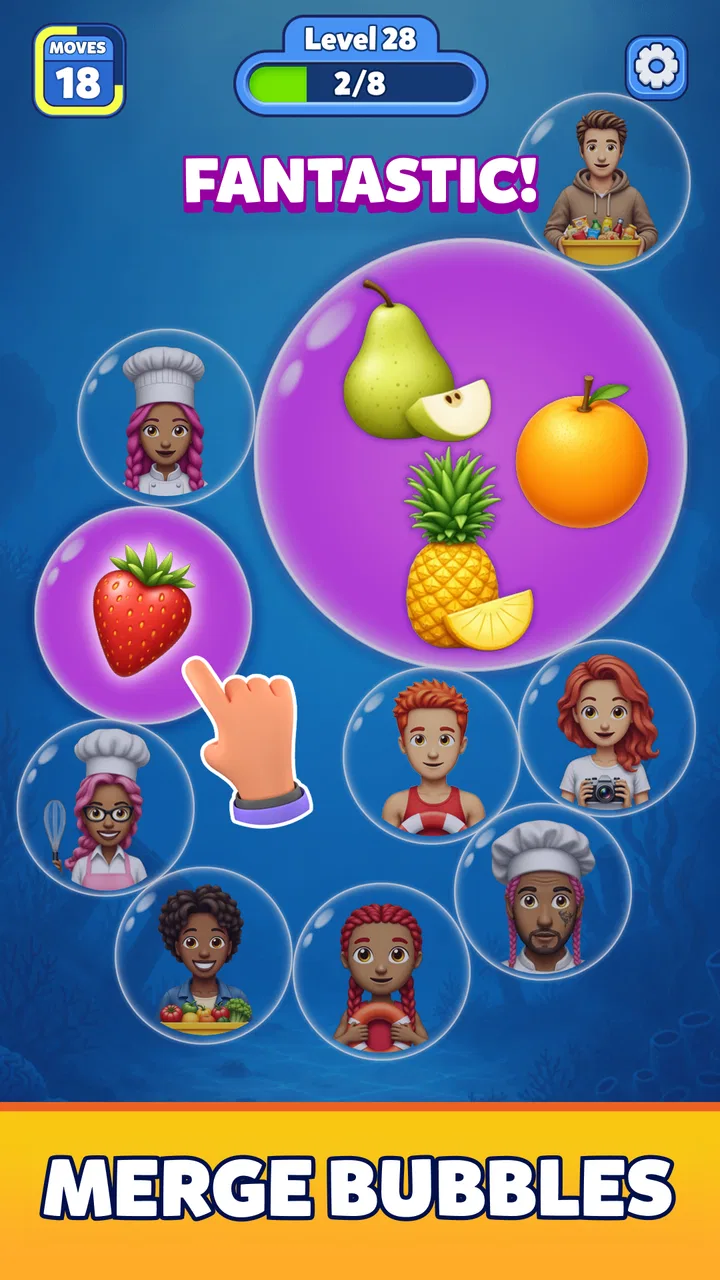
I downloaded Bubble Match - Connect Puzzle expecting a quick matching game, and that is exactly where its appeal begins. It is a free puzzle game from MagicLab built around connecting adorable bubble characters according to categories. The idea is easy to understand almost immediately, but the decisions become more interesting once the board asks me to look beyond the most obvious pair.
That first impression matters because this is not a game that demands a long explanation before it becomes enjoyable. I can open it, understand the visual goal, make a few moves, and decide within minutes whether its style suits me. For short breaks, that directness is a real advantage. I do not need to learn a complicated control scheme or remember a large story before playing.
My overall experience is pleasant, especially when I want a calm logic challenge rather than an intense arcade session. The cute presentation makes the game approachable, while the category-based matching gives the basic connection mechanic a little more thought than simple color matching. Still, its strongest quality is not endless depth. It is the way it fits into small pieces of spare time without making me feel that I have started something I must finish immediately.
You May Also Like

 Blood Strike: 2.5 Anniversary
Blood Strike’s Loadouts Turn Every Drop Into a Tactical Gamble
A close look at Blood Strike’s custom loadouts: how fast access to signature weapons reshapes its battle royale rhythm, rewards preparation, and narrows the gap between fights.

 Pandora - Music & Podcasts
Pandora’s Music Is Easy to Start, but Harder to Recover
Pandora’s strength is its low-effort path from a seed to a station. Its weak spot is how much confidence it asks you to place in connection, setup, and quiet recovery.

 8 Ball Pool
 Is Built on Rivalries, Rematches, and Routine
A close look at the rivalries, rematches, shared routines, and unanswered safety questions that turn a quick pool match into a persistent mobile community.

 Samsung Music
’s Quiet Strength Is Playing What You Already Own
Its reach comes less from spectacle than from dependable access to a personal library. That simplicity is both the app’s strongest retention engine and its ceiling.

 AccuWeather: Weather Radar
AccuWeather Review: A Quick, Clear Forecast for Everyday Decisions
For everyday plans, the best forecast is the one you can understand quickly. AccuWeather makes rain timing, radar, and local conditions easy to act on, with a few trade-offs.

 Hill Climb Racing
Why Hill Climb Racing Still Turns Crashes Into One More Run
A tiny car, a bumpy hill and one more upgrade: Hill Climb Racing keeps resurfacing because its simple chaos makes every near-miss feel personal.
More From Our News Desk
View All News


Why the first few moves work so well
The central task is simple: connect bubble characters that belong together by category. That gives each move two layers. I am looking at the characters themselves, but I am also checking the relationship that makes them a valid match. This small distinction keeps the opening moments from feeling completely automatic.
I found the game easiest to enjoy when I treated each board as a visual sorting problem. Instead of dragging my attention randomly across the screen, I first scanned for obvious groups, then checked whether connecting one set would block or complicate another. That habit makes the puzzle feel more deliberate without turning it into a heavy brain workout.
The cute bubble characters also soften the experience. A more severe visual style might make the same logic feel demanding, but here the atmosphere encourages experimentation. I was comfortable trying a connection, noticing the result, and adjusting my approach. That makes it suitable for players who like puzzles but do not want a stern or technical presentation.
One useful detail is that the category rule gives me a reason to slow down before acting. In many matching games, the best move is simply the fastest visible match. Here, I get more value from identifying the broader grouping first. The smartest opening move is often the one that preserves options, not the one that clears the first obvious pair. That is a small but meaningful change in how I play.
This also makes the game a good fit for a short mental reset. I can play while waiting for an appointment, during a quiet commute, or between household tasks. It delivers a little concentration without requiring the emotional investment of a competitive game. If I only have a few minutes, I can still understand what I am doing and feel that I made progress through my own choices.
A rhythm designed for brief breaks
The session rhythm is the main reason I would recommend it to casual puzzle players. The game gets to the point quickly, and the basic objective remains readable while I am playing. There is no need to spend the first part of a session navigating a complicated system. I can focus on the characters, the categories, and the available connections.
That clarity is especially useful when my attention is divided. If I pick it up while waiting for water to boil or while taking a short break from work, I do not need a long period of concentration before the puzzle makes sense. I can inspect the board, make a few careful decisions, and stop when the moment is over.
At the same time, the game is not so mindless that it becomes background tapping. The category requirement gives me a reason to compare choices. When several possible connections appear, I have to decide which one is safest and which one may leave a better arrangement for later. The pleasure comes from that small amount of planning rather than from speed.
I would not describe the experience as a demanding strategy game. Its logic is approachable, and that is intentional. Players looking for deep systems, elaborate level design, or a long-term competitive ladder may find the structure too light. For me, that limitation is acceptable because the game succeeds at a narrower job: offering a clear puzzle that can be enjoyed in short, low-pressure sessions.
One practical way to get more from each session is to avoid making the first available connection immediately. I usually take a moment to identify every category I can see, then choose the move that leaves the most recognizable options. This is not a complicated technique, but it prevents the game from turning into a sequence of guesses. It also makes the satisfaction feel earned rather than accidental.
Stopping is easier than in many mobile puzzles
Interruption tolerance is another strong point. A game like this works best when I can put it down without feeling punished for answering a message or returning to a task. Its simple visual objective helps because I can usually remember what I was considering: a category, a possible connection, or a group that needed attention.
That makes it a better companion for fragmented time than games built around long battles, timed events, or elaborate chains of actions. If I am interrupted, I do not feel that I have ruined a carefully prepared run. I can return and resume the same kind of visual reasoning without rebuilding a large mental state.
This quality also makes it suitable for shared household routines. Imagine playing while waiting for a child to finish getting ready. I can examine the board, put the phone down when needed, and come back without the game competing aggressively for my attention. That is a realistic advantage, not just a convenience. Many mobile games are designed to keep pulling the player back, while this one is easier to fit around ordinary responsibilities.
There is a trade-off, though. A relaxed, interruption-friendly design may feel less exciting to someone who wants constant urgency. If you enjoy countdowns, dramatic consequences, or rapid-fire competition, the same calm rhythm may seem flat. I would choose this game for a quiet pause, not for an adrenaline hit.
When I return after a break, my best approach is to recheck the categories rather than trust my first impression. A short interruption can make a previously obvious connection look different. Taking that extra scan is useful because it restores context without requiring a full restart in my head. It is a small workflow that makes the game feel more forgiving during everyday use.
Where the pleasure stays fresh and where it fades
The immediate pleasure comes from recognition. I see related bubble characters, connect them, and receive the simple satisfaction of making the board more orderly. The interaction is easy to grasp, and the visual theme gives the action a friendly personality. For a few minutes at a time, that loop is enjoyable.
Replay value depends more on how much I enjoy the act of sorting and planning than on a large sense of progression. I can return because the puzzle itself is relaxing, because I want another small challenge, or because I like improving the way I inspect a board. That is a valid kind of replay value, but it is different from the powerful long-term pull of a collection game or a story-driven adventure.
I noticed that repetition becomes more apparent when I play for too long in one sitting. The central action remains pleasant, but the novelty of connecting cute characters naturally wears down if I keep repeating the same type of decision without a change of mood. My recommendation is to use it in short bursts. The game feels better when I leave while the simple loop is still satisfying.
This is also where expectations matter. Someone comparing it with a traditional match-three game may look for cascading combinations, special pieces, or a constant stream of visual effects. Someone comparing it with a large logic-puzzle collection may expect many different rules. Bubble Match sits between those expectations: it has a recognizable matching foundation, but the category-based connection idea asks for a little observation rather than pure reflex.
Compared with a standard color-matching alternative, I prefer this game when I want to think about meaning and grouping instead of only visual alignment. Compared with a more complex logic title, I prefer it when I want a gentle entry point and less mental overhead. The choice is not about which style is universally better. It depends on whether I want immediate comfort or a deeper challenge that takes longer to learn.
A useful habit for replay is to change the way I scan the board. On one attempt, I can begin with the rarest-looking category; on another, I can map the most crowded group before touching anything. This creates a little self-imposed variety without pretending that the game is a completely different puzzle genre. It also helps reveal whether I genuinely enjoy the reasoning or am only responding to the first visual novelty.
Who will enjoy it most
I think the game is a good match for people who like approachable puzzle games, cute visual themes, and sessions that do not require a major time commitment. It can work for a casual player who wants something more thoughtful than tapping through a passive distraction, but less demanding than a serious strategy title.
It is also a sensible choice for families looking for an Everyone-rated game with a straightforward premise. The category concept is easy to explain, so a new player can understand the goal through a quick demonstration. I would still encourage younger players to use normal device and purchase safeguards, particularly because the game includes optional in-app purchases.
The purchase range runs from $1.99 to $99.99 per item, so the free entry point is useful, but I would not treat the game as automatically cost-free in practice. If I were handing it to someone who dislikes spending prompts, I would set expectations first and check the device’s purchase controls. That is especially important for a game whose gentle presentation may make it feel aimed entirely at children, even though purchase decisions still belong with the account holder.
The game has reached over 100K installs and holds a 4.0 average from around 87 ratings. Those figures suggest a modest but real audience, and they fit my impression of a focused casual title rather than a massive social platform. I would read that as evidence of accessibility, not as a promise that it will replace every other puzzle game on a player’s phone.
MagicLab has kept the technical entry point fairly broad as well. The current version is 1.1.1 and requires Android 8.0 or later, which means the game is available to many people using older but still functional devices. The release date is May 22, 2026, so players should view it as a relatively new title and allow their opinion to come from the actual play experience rather than expecting a huge, mature ecosystem around it.
Who should choose another puzzle instead
I would skip this game if my main priority were deep progression, a large variety of puzzle rules, or high-pressure competition. The category-connection idea is clear and pleasant, but clarity can also limit complexity. Players who need constant surprises may quickly feel that the core loop is too narrow.
I would also choose another option if I wanted a game that rewards long uninterrupted sessions. The design is better suited to small visits than to an evening-long commitment. Playing for too long can make the repeated matching structure more noticeable, while a richer puzzle collection might provide more substantial changes from one challenge to the next.
There is another important distinction between relaxation and achievement. If I want to chase leaderboards, compare detailed performance statistics, or build a powerful collection, this is probably not my first choice. Its appeal is more personal: I am organizing what I see, making sensible connections, and enjoying a tidy little mental exercise.
Even so, I would not dismiss it as shallow simply because it is casual. The category rule adds enough judgment to make careless play less satisfying. The game rewards patience, visual grouping, and the ability to leave a promising option open. Those qualities give it more substance than the short summary might suggest, provided I approach it as a compact logic pastime rather than a full-scale puzzle platform.
My practical way to play
When I open the game, I begin with a complete visual scan. I look for the clearest categories and note which characters appear to have fewer possible partners. I then make the connection that reduces uncertainty without closing off several other choices. This takes only a moment, but it makes the session feel calmer and more controlled.
If the board becomes confusing, I stop trying to solve everything at once. I focus on one category, trace the possible connections, and only then compare that group with the rest. This is particularly helpful when several bubble characters look equally appealing. Breaking the board into small questions keeps the game accessible without removing the logic.
I also avoid treating every session as a test of endurance. A good stopping point is after a satisfying sequence of decisions, not only after I have played until the loop feels repetitive. That approach protects the game’s best quality: its ability to provide a pleasant little reset whenever I have a spare moment.
For someone deciding whether to install it, I would ask one simple question: do you enjoy sorting visual information and making low-pressure choices? If the answer is yes, the free download makes it easy to try, and the Everyone rating keeps the premise broadly approachable. If the answer is no, the cute characters alone may not be enough to carry repeated sessions.
My casual verdict
Bubble Match - Connect Puzzle is a friendly, focused game that understands the value of a quick start and an easy exit. I like that the category-based matching gives the cute presentation a real puzzle underneath it. The experience is not built around stress or spectacle; it is built around noticing relationships, choosing a sensible connection, and enjoying a small moment of order.
Its limitations are just as clear. The loop can feel repetitive during long sessions, and players seeking advanced systems or competitive pressure will probably outgrow it. The optional purchase range also means I would pay attention to device controls before letting someone else play freely. Those points do not ruin the experience, but they are part of making a realistic recommendation.
For me, this is best as a pocket-sized logic break: something to open while waiting, pause when life interrupts, and revisit when I want a gentle mental nudge. I would recommend it to casual puzzle fans who value immediate clarity and relaxed replay. I would point dedicated puzzle enthusiasts toward a deeper alternative if they want more variety. Within its smaller aim, though, MagicLab’s game delivers a pleasant and approachable way to connect, sort, and think for a few minutes.
FAQs for Bubble Match - Connect Puzzle
01What is Bubble Match - Connect Puzzle?
Bubble Match - Connect Puzzle is a colorful and engaging puzzle game where players connect bubbles of the same color to clear levels. It combines strategic thinking with fun gameplay, offering various challenges and power-ups as you progress through the levels.
02Is Bubble Match - Connect Puzzle free to play?
Yes, Bubble Match - Connect Puzzle is free to download and play. However, it offers in-app purchases for players who wish to enhance their gaming experience with additional features, power-ups, or to remove ads. These purchases are optional and not required to enjoy the game.
03What platforms is Bubble Match - Connect Puzzle available on?
Bubble Match - Connect Puzzle is available on both Android and iOS platforms. Players can download the game from the Google Play Store for Android devices and the Apple App Store for iOS devices, ensuring a wide reach across different devices.
04Does Bubble Match - Connect Puzzle require an internet connection?
Bubble Match - Connect Puzzle can be played offline, making it perfect for on-the-go gaming without worrying about an internet connection. However, certain features, like leaderboards and in-app purchases, require an internet connection to function.
05Are there any tips for progressing faster in Bubble Match - Connect Puzzle?
To progress faster, focus on creating longer chains of bubbles to earn more points and unlock power-ups. Utilize boosters strategically and complete daily challenges to gain extra rewards. Additionally, revisiting previous levels can help improve your skills and strategies.
Pros
- Intuitive interface makes it easy to learn.
- Colorful graphics enhance user experience.
- Levels increase in difficulty
- adding challenge.
- Offline mode available for uninterrupted play.
- Frequent updates with new levels and features.
Cons
- Ads can be intrusive during gameplay.
- Some levels may feel repetitive.
- In-app purchases can be expensive.
- Occasional lag on older devices.
- Limited social features for connecting with friends.

Bubble Match - Connect Puzzle
Gallery